Color Rotation
Collect colors. Complete sequences. Outsmart your opponents.
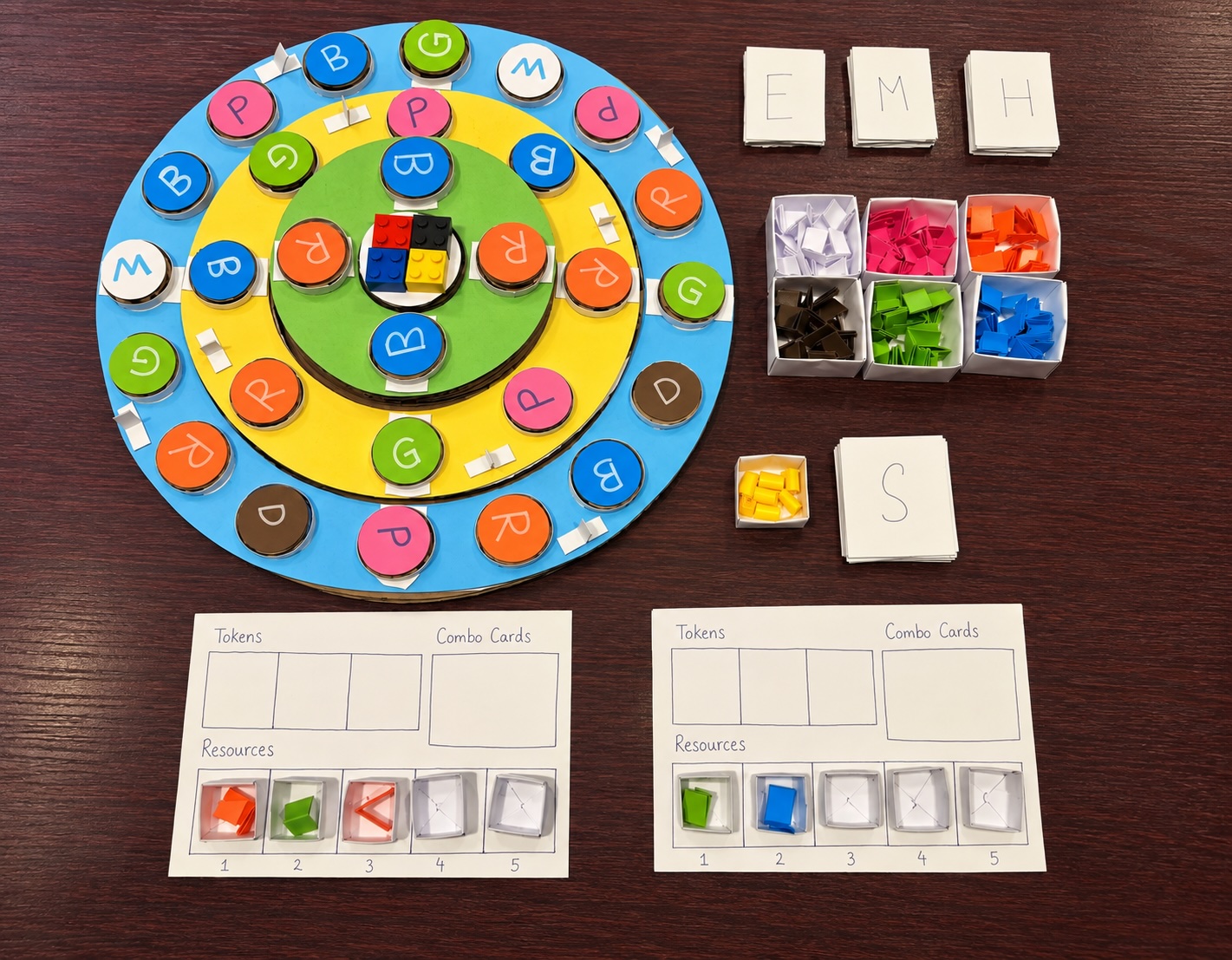
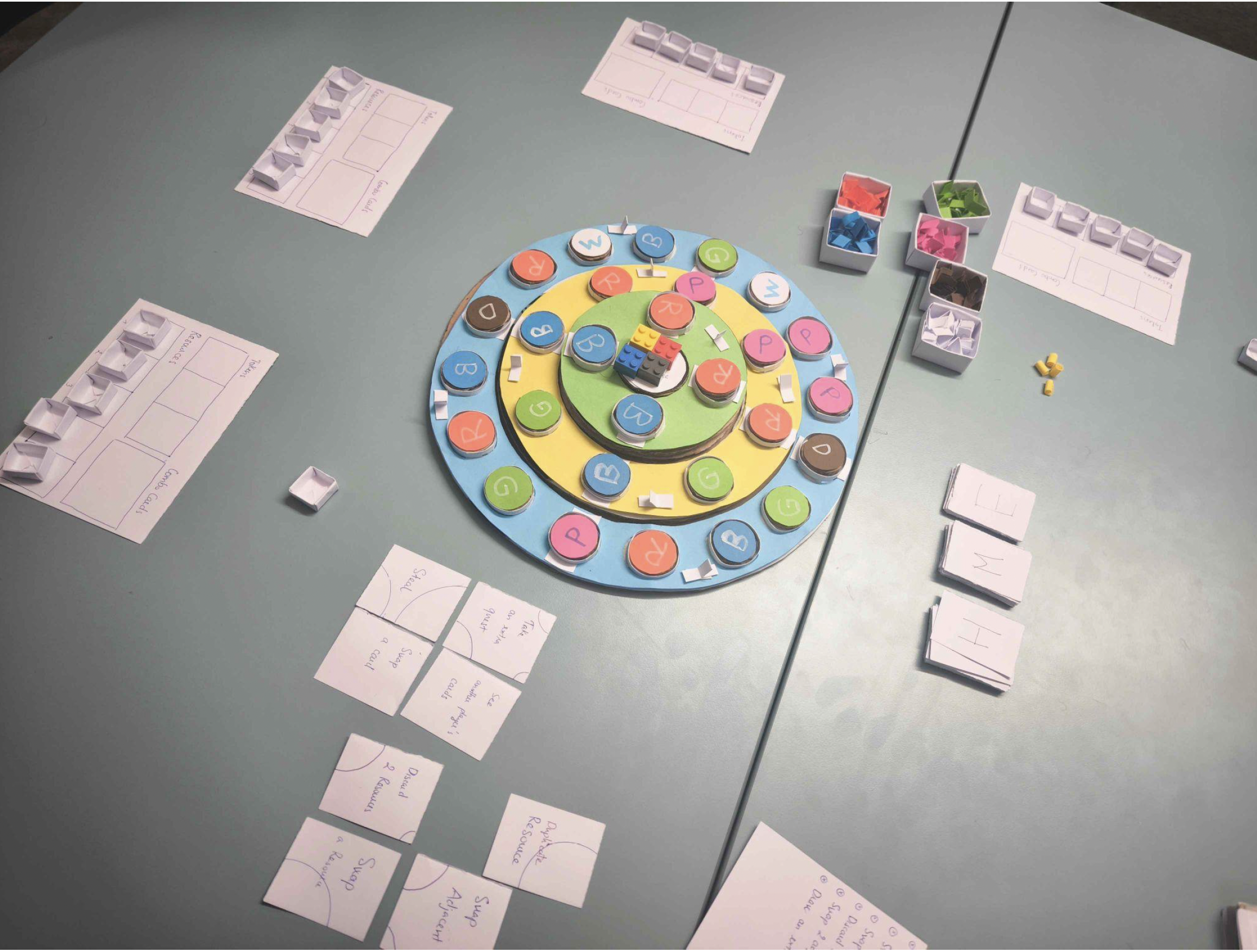
The prototype: a board with three rotating layers, Colour Blocks, Quest Cards, Tokens and Player Mats.
What is it?
Color Rotation is a competitive board game about movement, colour and strategy.
Players move across a rotating board, collect Colour Blocks and arrange them in the right order to complete Quests.
What’s in the box
The full prototype, for reference.
12345678- 14 Player PiecesLEGO pieces. Everyone starts in the centre.
- 21 Board with 3 rotating layersBlue, yellow and green layers turn on their own.
- 3BGPRWD28 coloured Tiles16 on blue, 8 on yellow, 4 on green.
- 4BGPRWD120 Colour Blocks20 in each of the 6 colours. Colour only, no letters.
- 54 Player MatsSpace for Tokens, cards and your 5-block sequence.
- 612 yellow TokensUsed to get Special Cards. Not Colour Blocks.
- 7S8 Special CardsExtra abilities.
- 8EMH36 Quest Cards12 Easy, 12 Medium and 12 Hard.
From first move to 7 points
How a game goes, from the first step to the last.
- 1Place the tiles
Place the colour tiles randomly across the three layers.
- 2Take a mat and a player piece
Each player takes a Player Mat and places their piece on the centre tile, where everyone starts.
- 3Take your Quest Cards
Each player starts by taking one Easy, one Medium and one Hard Quest Card.
- 4Spend 2 Action Points
Choose what to do. Each action costs Action Points:
- Rotate your layer1 Action Point
- Move one tile1 Action Point
- PRemove a Colour Block1 Action Point
- Take a Token2 Action Points
For example: Rotate + Move, or Move + Move.
See an example turn - 5Collect a Colour Block
Moving onto a tile gives you its Colour Block. Add it to either the start or the end of your row.
See how the sequence works - 6Complete a Quest
Each Quest Card shows a short colour sequence. When your row contains those colours next to each other, in the same order, you complete the Quest and score its points. The matched blocks leave your row. This costs no action points.
See a Quest completed - 7Pass the turn
Your turn ends. The next player takes their turn.
- 8Reach 7 points
The first player to 7 points wins.
One turn
Rotate, then move and collect. 2 Action Points used.
Turn a layer 90°. Here the yellow layer turns, and a blue tile moves next to you.
1 Action PointMove to a neighbouring tile and collect its Colour Block. Collecting costs nothing extra.
1 Action PointYour row of 5
Keep up to 5 Colour Blocks in a row on your Player Mat.
Each new Colour Block goes on the left end or the right end of your sequence. You choose.
Adding a block on one end pushes out the block on the opposite end.
Complete a Quest
Match the card’s colours in order, score, and the matched blocks leave.
Orange, blue and pink are removed. Green and white stay.
Tokens and Special Cards
Yellow Tokens are not Colour Blocks. Collect Tokens to get Special Cards, which can disrupt other players.
A player uses Send back.
The card targets another player’s piece.
Their piece goes back to the starting position in the centre.
Send back was in the first set of Special Cards. The set changed after playtesting (see Iteration).
What makes it different
Similar games
Both games involve collecting pieces and building sequences to score.
Color Rotation adds movement across a changing board, a limited 5-block sequence and direct player interaction.
How Color Rotation stands out
Rotating layers change available paths.
Players need the right colours in the right order.
Players can keep only 5 Colour Blocks.
Board rotation and Special Cards can disrupt another player’s plan.
From idea to playable prototype
I contributed throughout the full design process — from early ideas and prototyping to playtesting and iteration — as part of a collaborative team.
- Everyone contributed ideas during planning.
- We designed and tested the game together.
- During playtesting, we split into groups and rotated roles.
We brainstormed different ideas, discussed their strengths and weaknesses, and developed the strongest direction.
We created prototypes, tested them, identified problems and tried different solutions.
9 playtests across 3 days
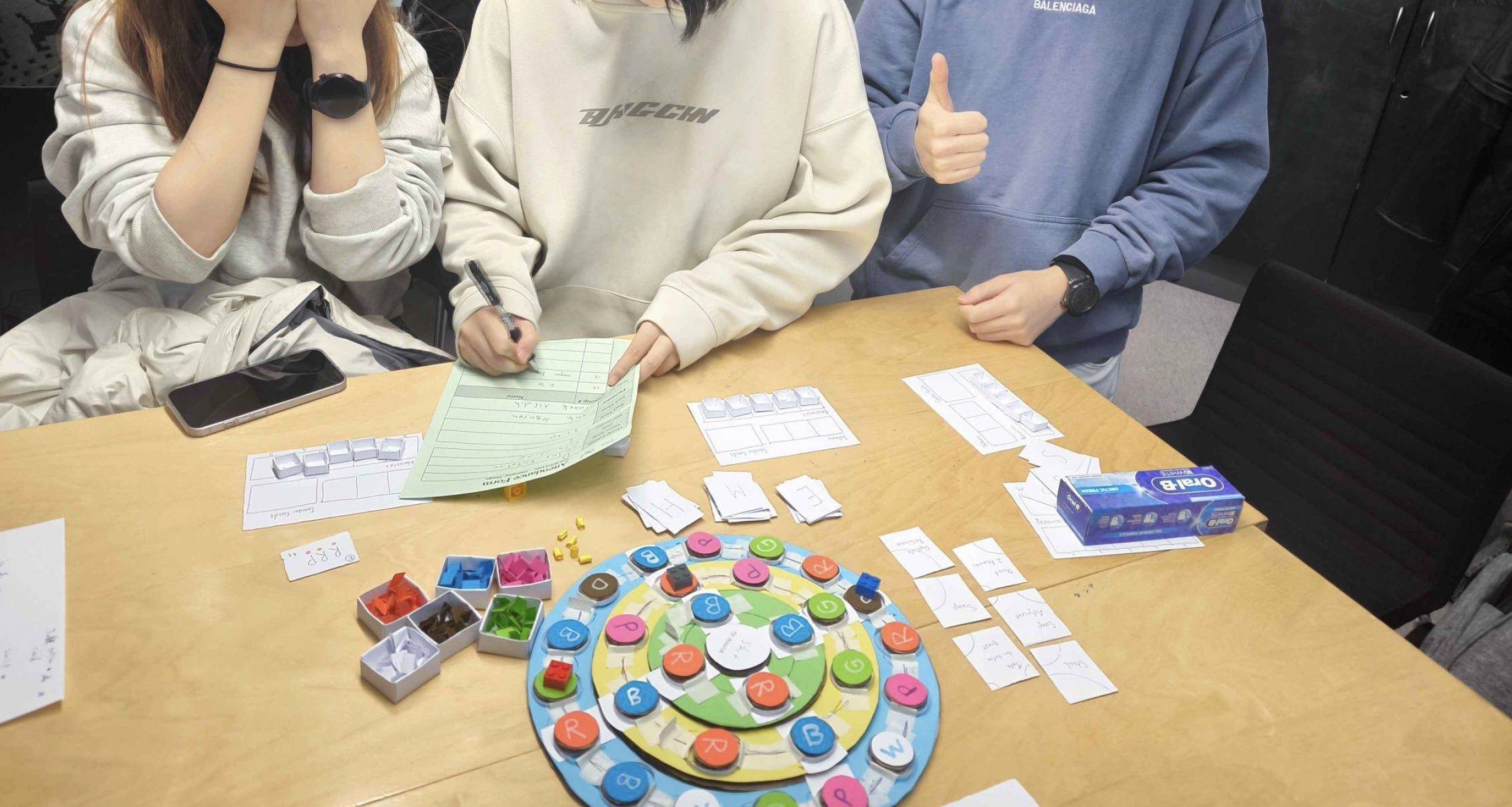
Can players understand the core game?
We exploredSession notes
- Session 1: first impressions of the basic actions. No goal and no Special Cards yet.
- Session 2: shifting Colour Blocks in the sequence, and Quests.
- Session 3: feedback on rotation and shifting. New instructions. No Quests or Special Cards.
- Session 4: basic actions with Quests. New instructions.
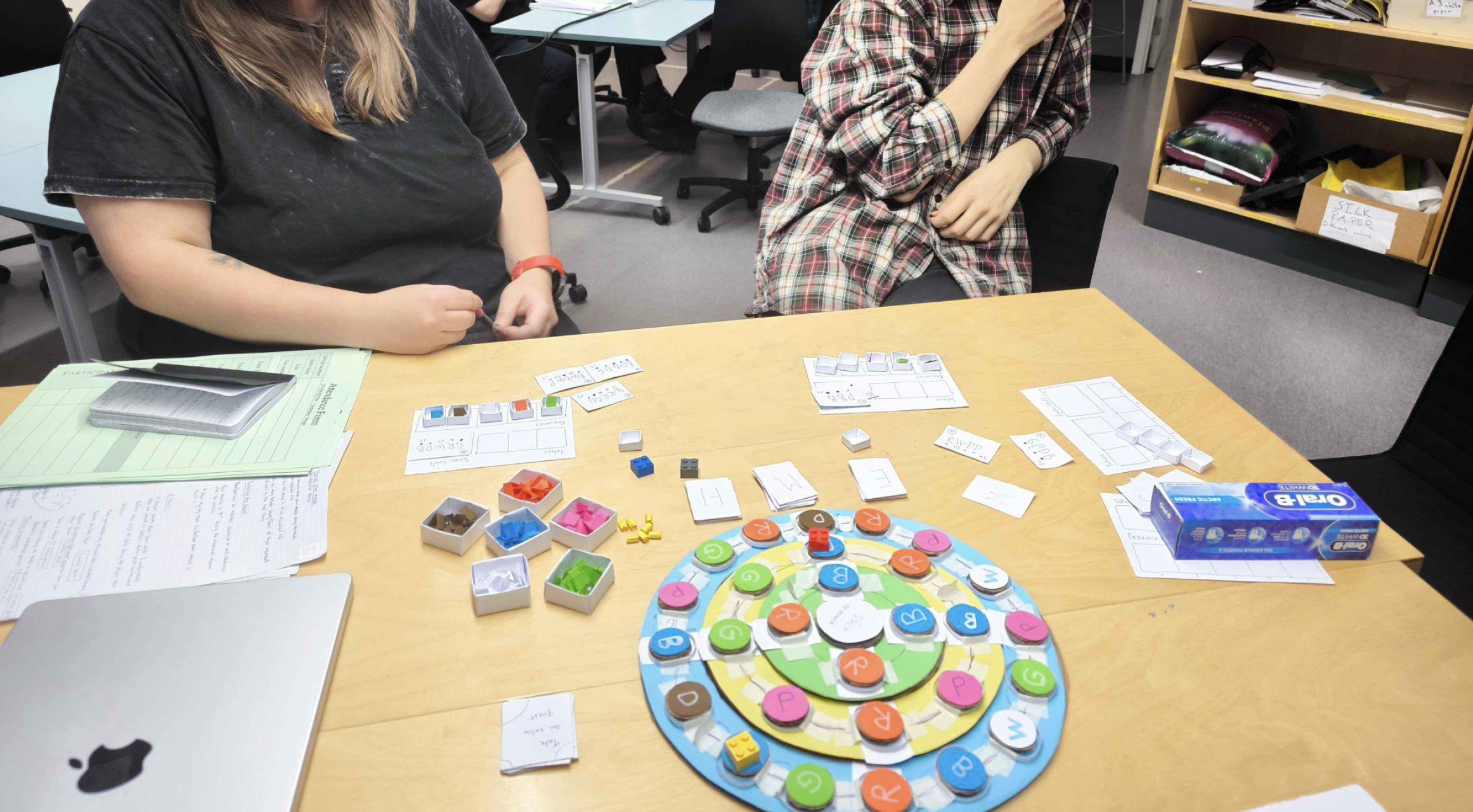
Are the systems balanced?
We exploredSession notes
- Session 5: Special Cards, given out free every 2 turns.
- Session 6: Quest timing. Players had to complete Quests in order of difficulty.
- Session 7: Quest balance with 2 players. One played only Hard Quests, the other only Easy and Medium.
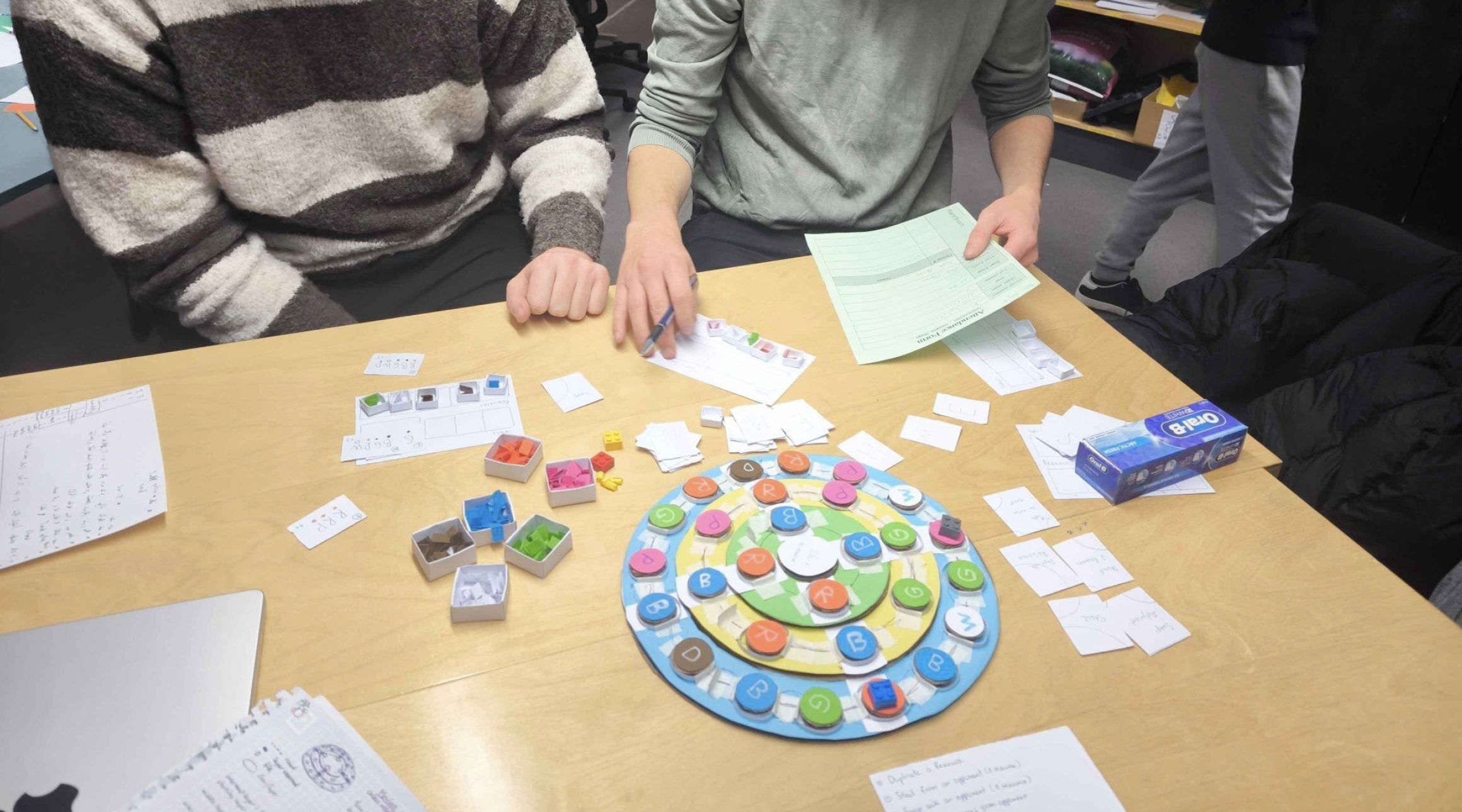
Does the complete game work?
We exploredSession notes
- Session 8: a full 4-player game, to test game length.
- Session 9: team play. 4 players in 2 teams, each team sharing a Player Mat, Tokens and Quests.
What we saw, and what we changed
Playtesting shaped the game. These are the main changes from the first concept to the final prototype.
Turns needed more flexibility
Players took a fixed set of actions every turn.
A 2-Action-Point system. Players choose how to spend each turn, with more actions to choose from.
A shorter win condition
Clearer guidance on the prototype
- Coloured board tilesEach tile shows the colour of the Colour Block you collect there.
- Double codingWe added another visual cue alongside colour on some game elements. For example, each tile shows a letter as well as a colour: B for blue, G for green. This use of double coding reduced reliance on colour alone.
- Action Point referenceA cheat sheet showing what each action costs.
Special Cards changed through testing
- Steal from another player
- Swap with another player
- Get a bonus Colour Block you already own
- Send another player back to start
- Steal
- Take an extra Quest
- Swap a card
- See another player’s cards
- Discard 2 Colour Blocks
- Duplicate a Colour Block
- Swap adjacent
We also changed what the cards cost.
What we would improve next
The course ended at this prototype stage. These improvements were identified but not implemented.
- Refine the physical prototype
- Apply double coding consistently
- Make paths between layers clearer
- Create a clearer rulebook
- Refine rules and examples
- Continue balancing Special Cards
- Explore information-sharing mechanics
- Develop the illustrations and visual style
What we learned
Early prototypes should be easy to change.
Playtesting revealed problems we could not see while designing.
Different play styles gave us different perspectives.
Small rule changes changed how players planned and interacted.
Trying to satisfy everyone can weaken the experience.
A game can be understandable without being enjoyable. Both need testing.